Cannoli and Labor Memory
Primo Maggio at the Old Labor Hall, Barre, Vermont—An essay and audio postcard from the Labor Memory Project
The above audio segment was featured on the Labor Heritage Power Hour Podcast on the Thursday Jun 11, 2026 “Solidarity, Mr. Frodo” Episode which aired live on WPFW 89.3 FM in Washington DC.
(*Correction from audio noted at end of essay)
Façade of the Old Labor Hall, Barre, VT
The invisible presence of the past at the Old Labor Hall in Barre, VT is palpable—its radical history feels as much a part of the building as the brick and plaster.
Formally titled the Socialist Labor Party Hall, the national historic landmark is an extremely unique site in the American landscape. It is only one of two surviving socialist halls left in the country—the other in Butte, MT has been renovated into “luxury apartments.” The Old Labor Hall in Barre, however, proudly serves the community as an education center, entertainment space, meeting hall for several Vermont labor unions and an intentionally affordable rental venue. The road from the hall's founding to its present has been anything but a smooth ride, but it has certainly been a fascinating one.
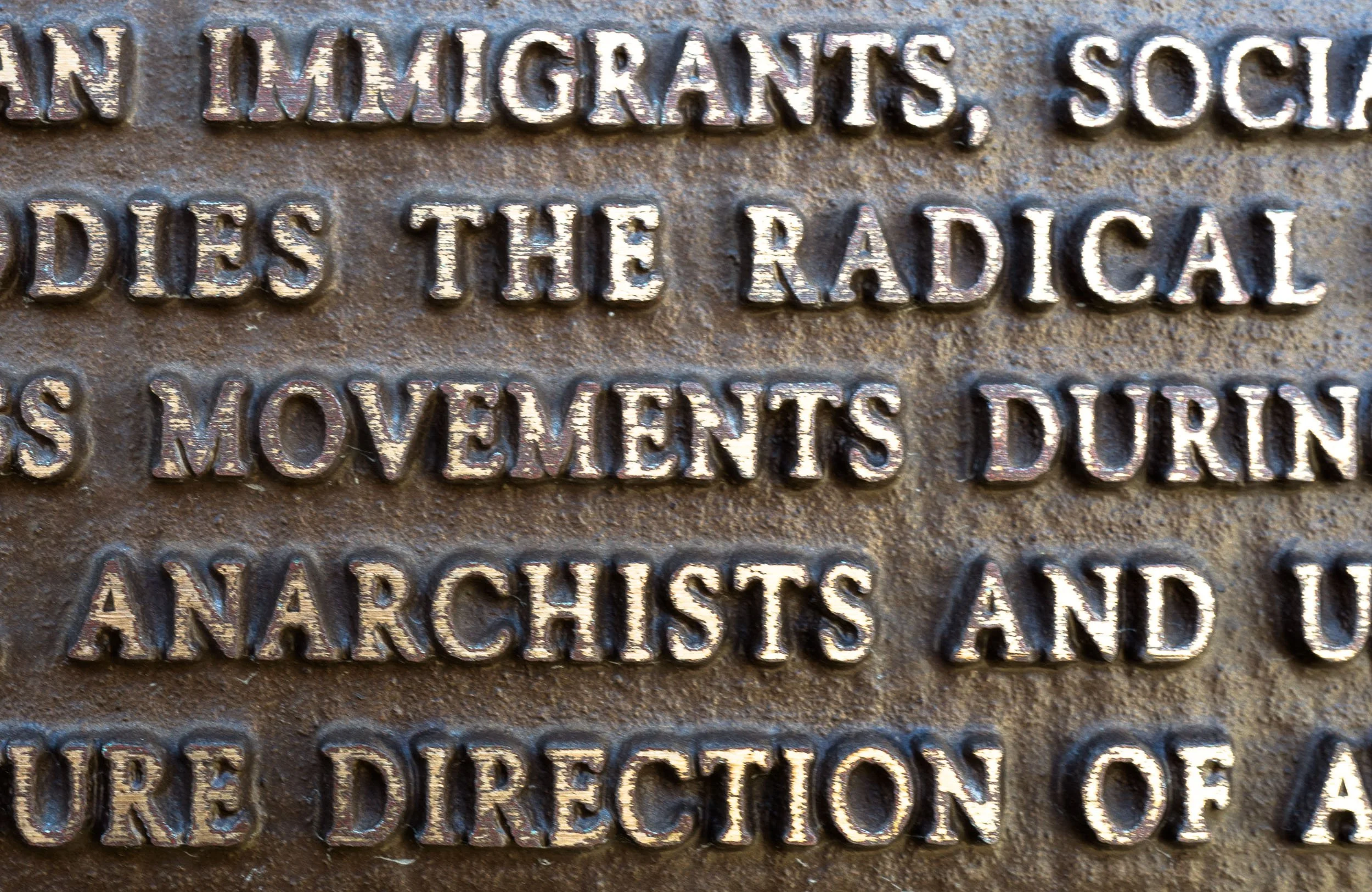
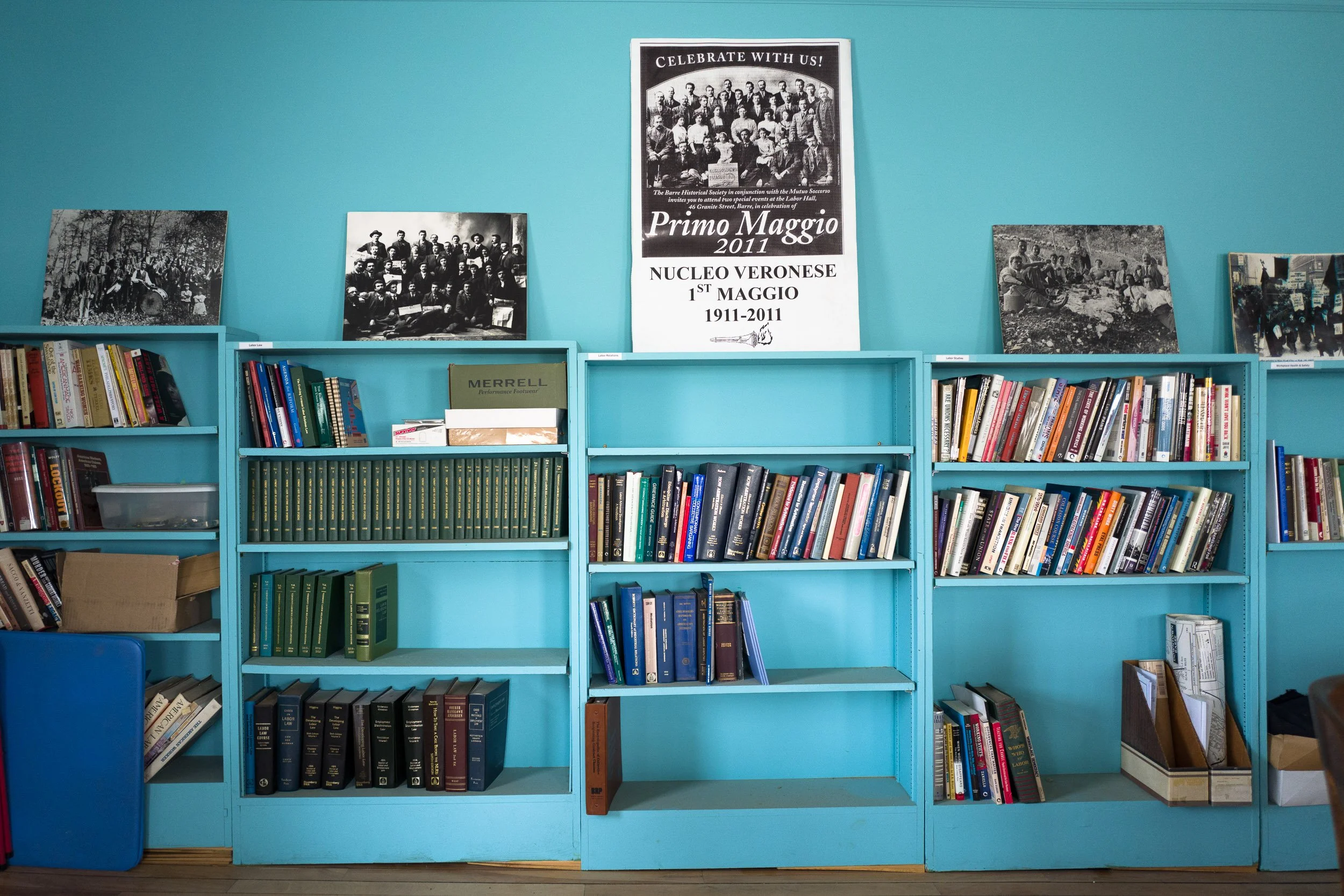
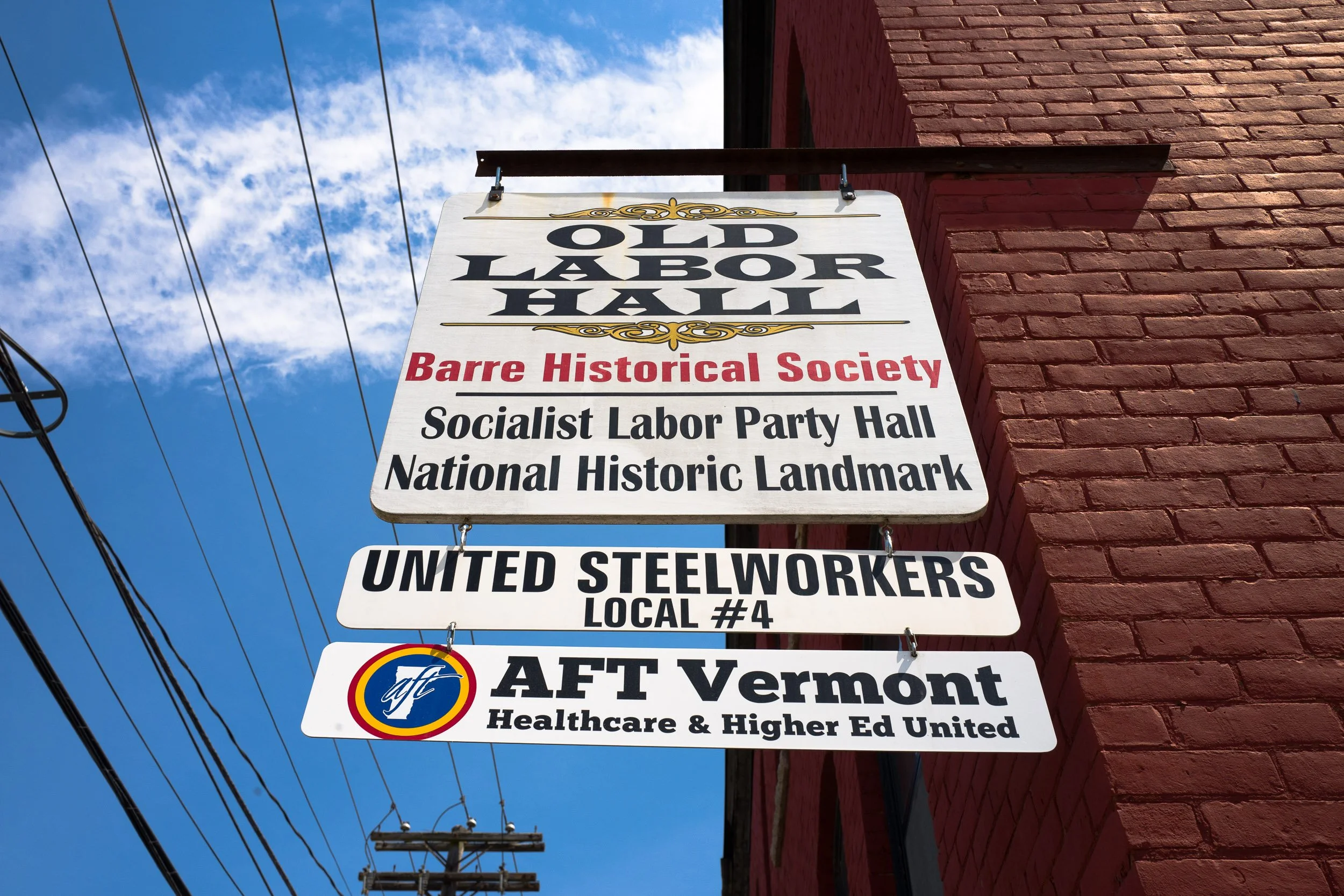
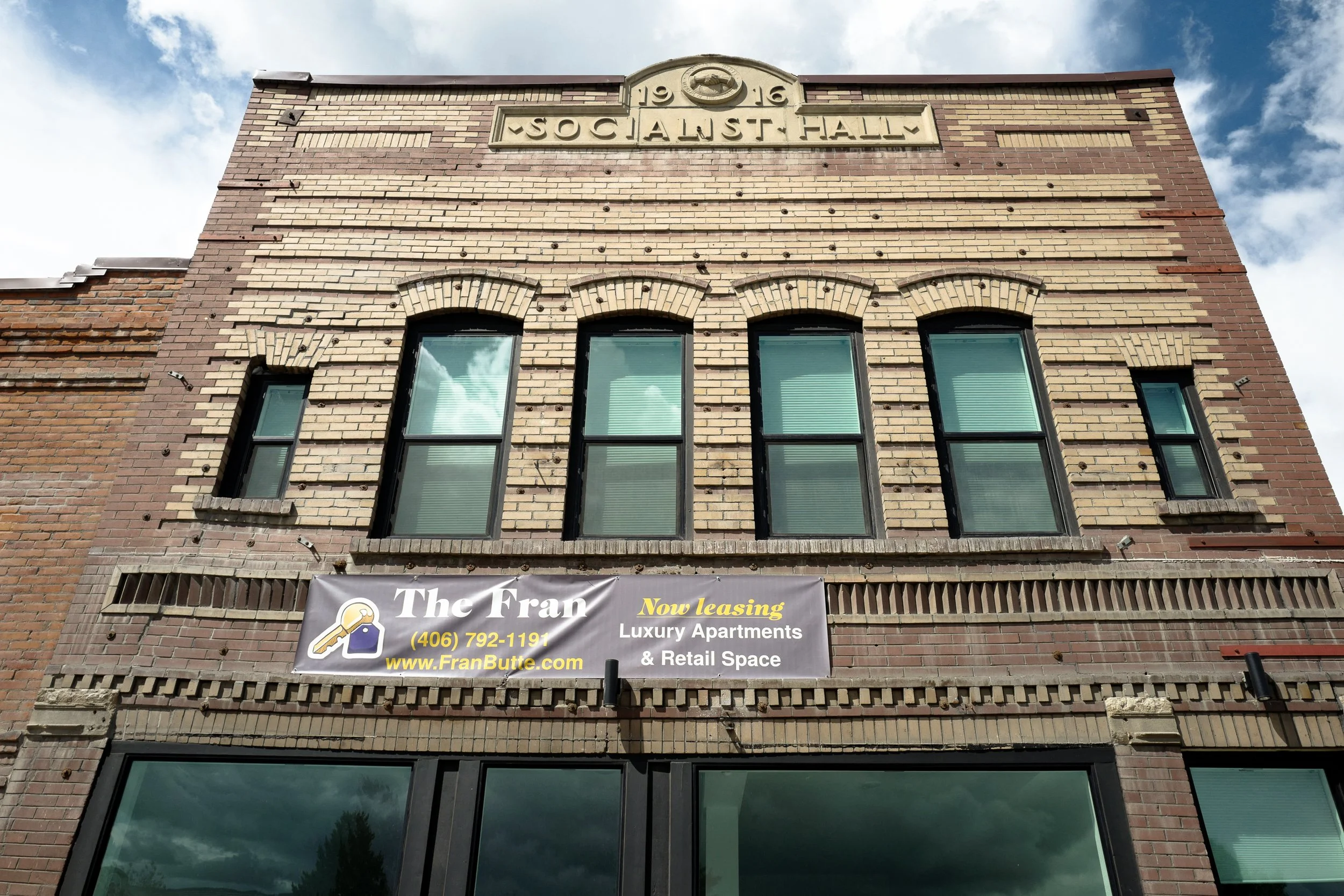
[Above photos: Detail of National Historic Landmark plaque, Hall library, Sign noting the unions currently utilizing the Hall as their meeting space, Façade of the only other surviving Socialist Hall building—now “The Fran” luxury apartments in Butte, MT]
Barre has been dubbed “the Granite Capital of the World” for its vast granite deposits and quality finished granite products, but it would be the skills and labor of immigrants from Scotland working its quarries and the artisan stone-cutters from Northern Italy who would earn the city its moniker. Along with their skills and labor, these immigrant groups would also bring across the ocean their heritage of trade unionism and radical politics.
Barre formed its first branch of the Granite Cutter's Union in 1886—what would become the Granite Cutters' International Association—becoming its largest branch with around 1,000 members by 1900, a time when ninety percent of all jobs in Barre were organized. It would be that same year when upwards of seven hundred people would attend the dedication of the Socialist Labor Party Hall. The hall was constructed by Italian immigrants to serve as a venue for union meetings, clubs and societies of radical politics, entertainment and to meet other various neighborhood needs. It soon became a major community center and an anchor of radicalism that would draw many notable speakers such as Eugene Debs, Bill Haywood and Mother Jones—anarchists Luigi Galleani and Emma Goldman were even both once residents of the city. Families in Barre also notably hosted children from Lawrence, MA during the 1912 Bread and Roses strike—holding a celebration banquet in their honor at the hall.
Children of the 1912 Bread and Roses strike gathered in front of the Hall—displayed at Old Labor Hall
The hall continued its mission of serving the community for several decades, particularly during the hardships of the 1930s. However, the combination of the Great Depression and repeated flooding of the nearby river eventually rendered the hall financially unsustainable. In 1936, the building was sold, spending its mid-life as a packing facility. In 1994, the owner declared bankruptcy and, during the building's clean-out, contents from the hall's attic were hauled off to a dump. Members of the community made efforts to recover the dozens of boxes of historical documents, but, sadly, were unsuccessful. The devastating loss of these records would become the spark that would lead to an incredible preservation effort—the Barre Historical Society purchased the hall the very same year.
Various government entities, community members and unions—including the Granite Cutters Association whose national office once resided in the building—donated money and labor to the hall's restoration efforts. Simultaneously, historians and community advocates worked to nominate the hall as a national historic landmark, which it would achieve in May of 2000. The Old Labor Hall officially reopened on Labor Day that same year, a full century after its dedication. There is a small photograph hanging in the hall of Bernie Sanders addressing the crowd at its reopening.
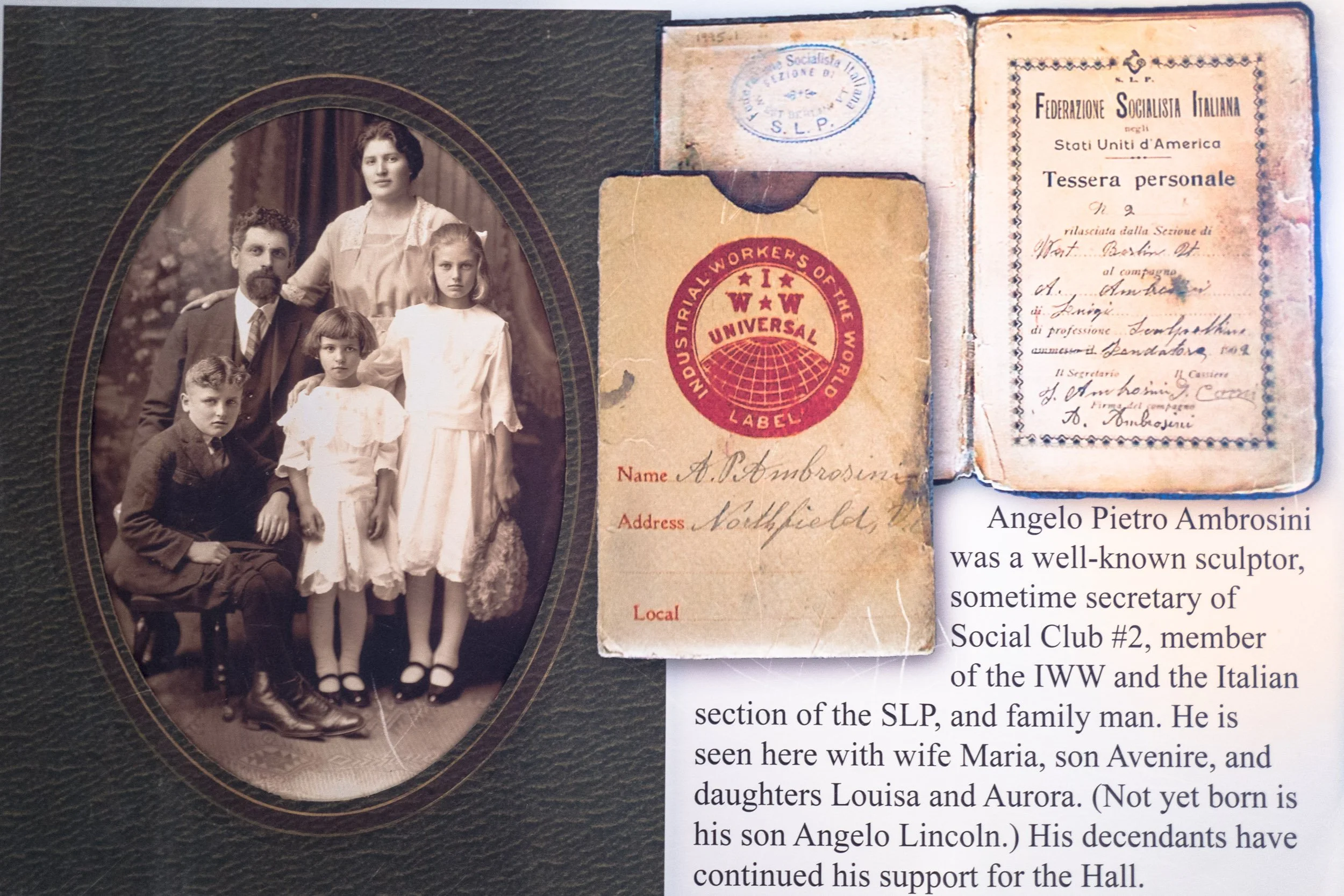
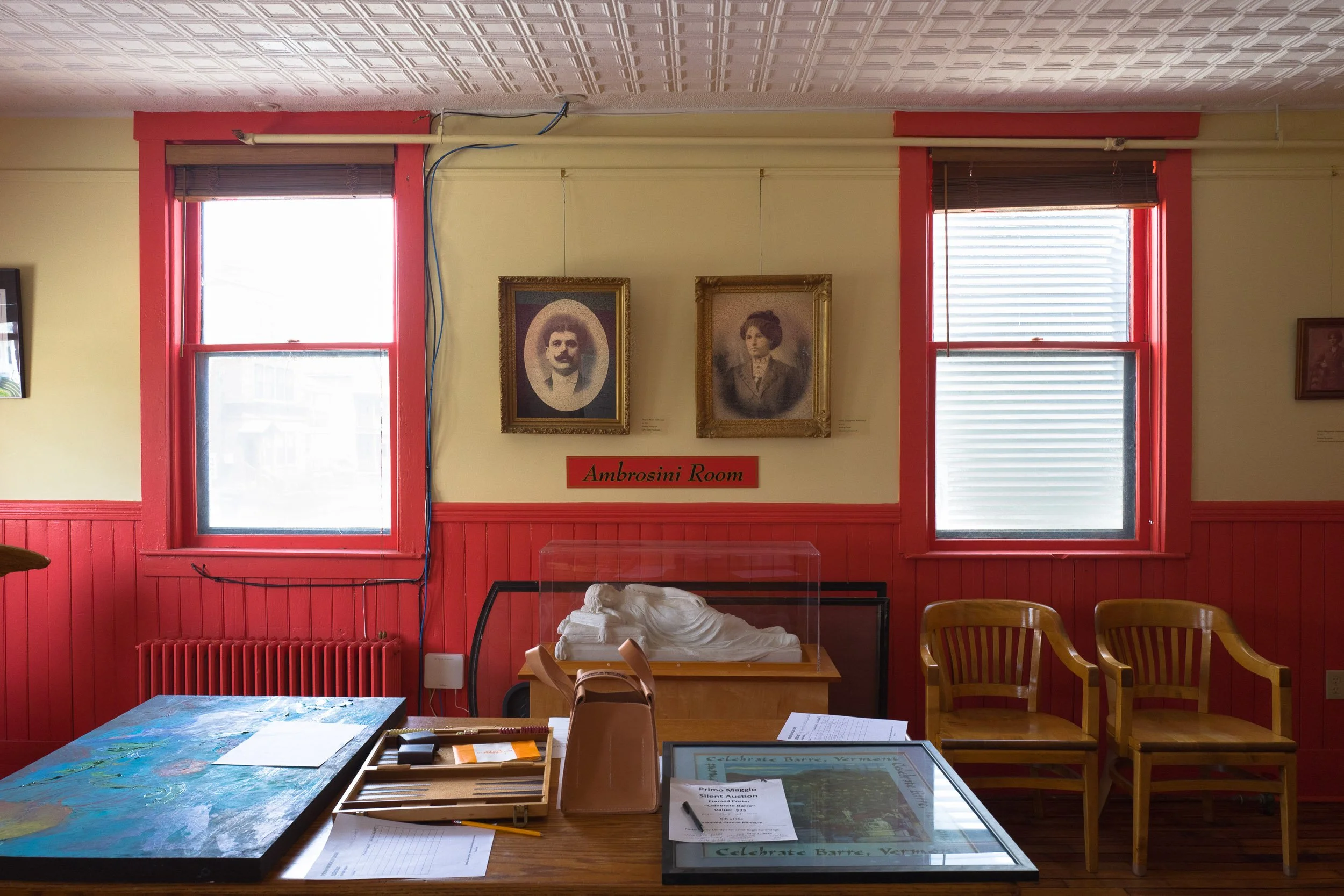
[Above photos: Portrait of the Ambrosini family displayed on the Hall’s historical information board, Ambrosini Room which honors the early leadership of husband and wife, Angelo and Maria.]
Over the last quarter century, the hall has continued its tradition of being a community space rooted in its radical history and the success of this mission may be no more apparent then at the annual Primo Maggio event. Italian for May 1st, the event is a community gathering observing International Worker's Day with various festivities, labor history lectures and a multi-course Italian dinner—which my family and I just happen to have had the luck of attending this year.
The place was brimming with life. We met many wonderful people throughout the evening, like those with whom we shared a table. To our left was a couple who donated the immense amount of excellent minestrone soup, which our four year daughter would not stop raving about. To our right was a couple with deep roots in the local Italian community and one of whom, John, repaired and renovated the plaster for the entire building—something he was asked to stand and be recognized for during the evening. After cannoli were served, the crowd listened to their guest speaker, Prof. Erik Loomis, author of A History of America in Ten Strikes.
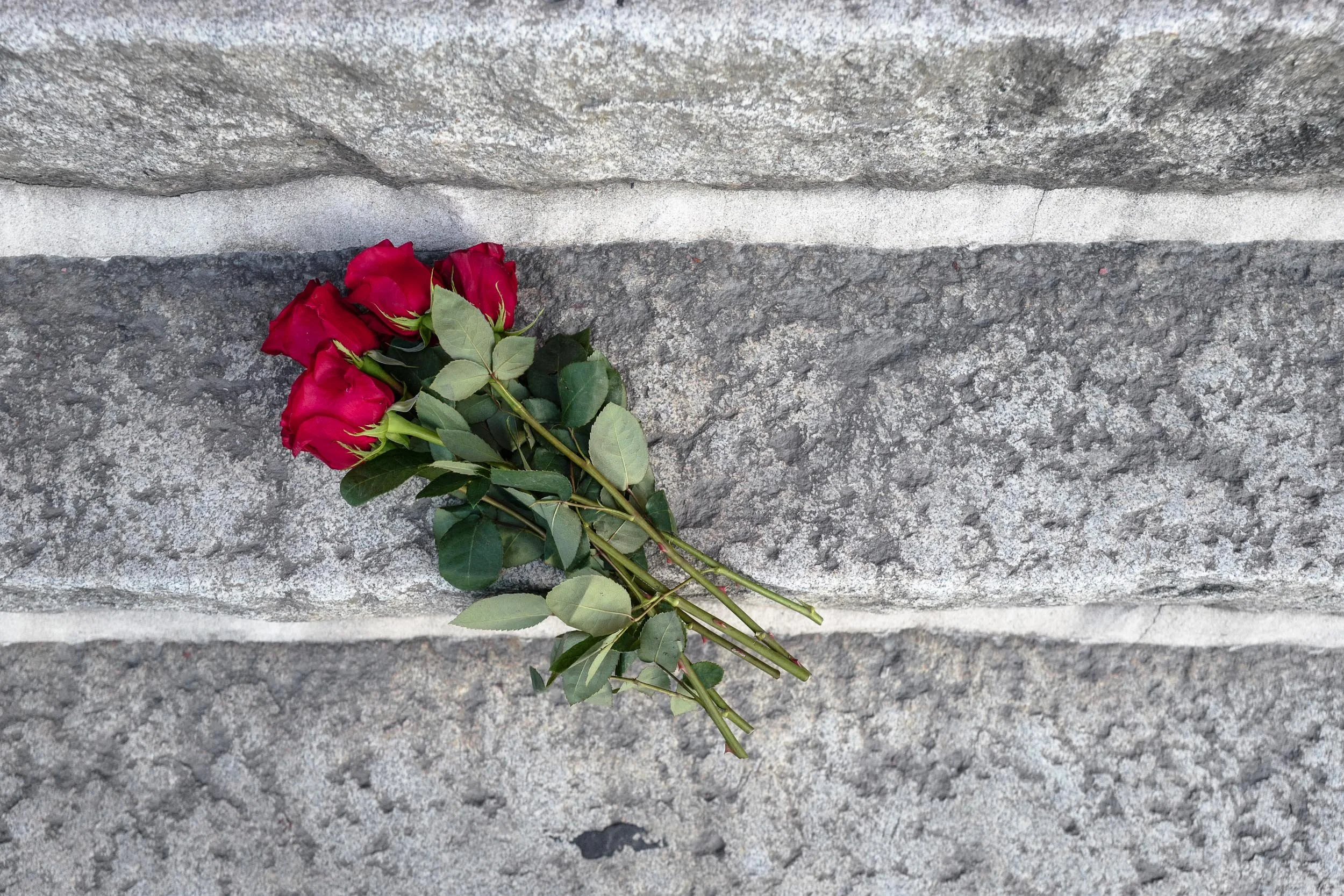
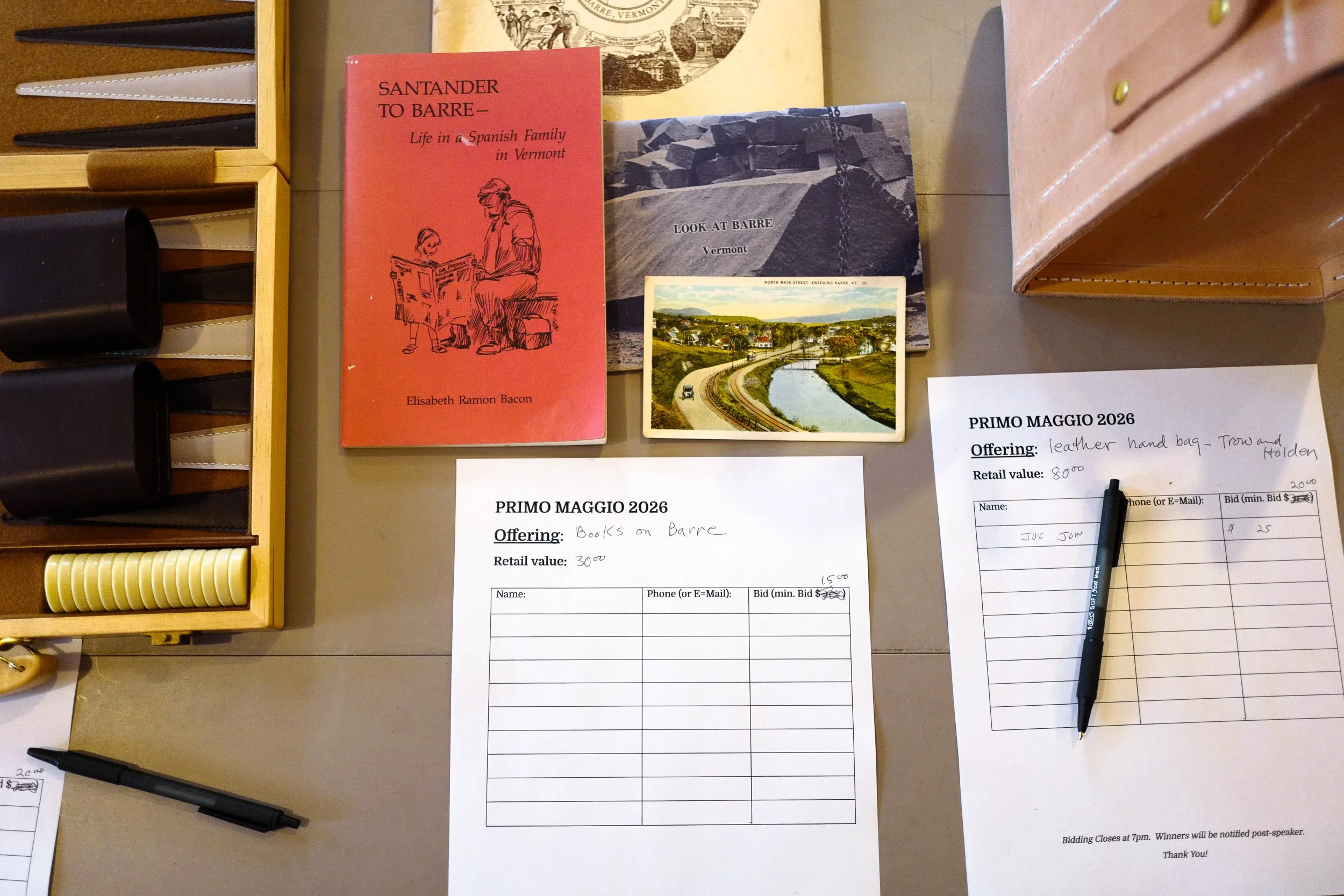
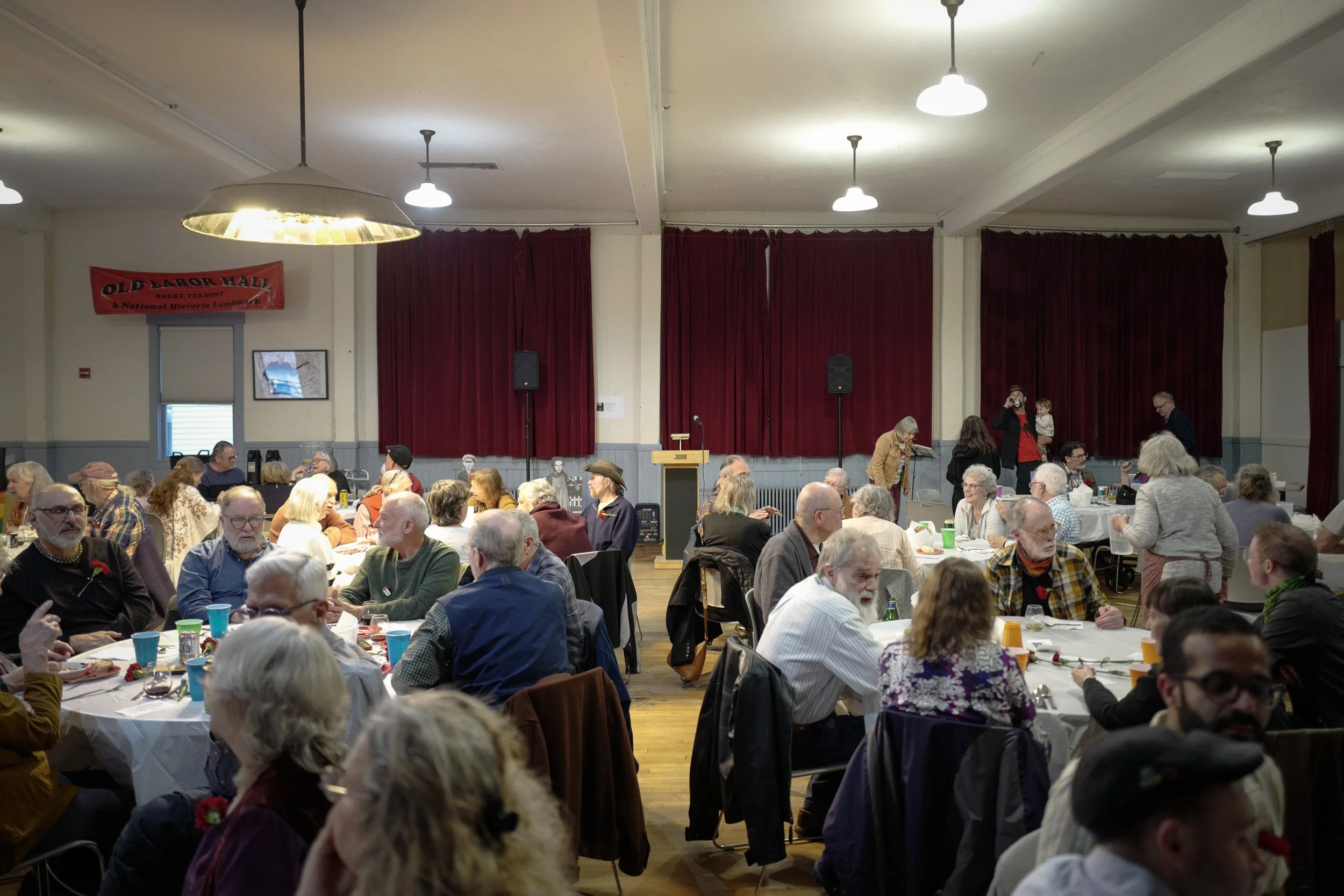
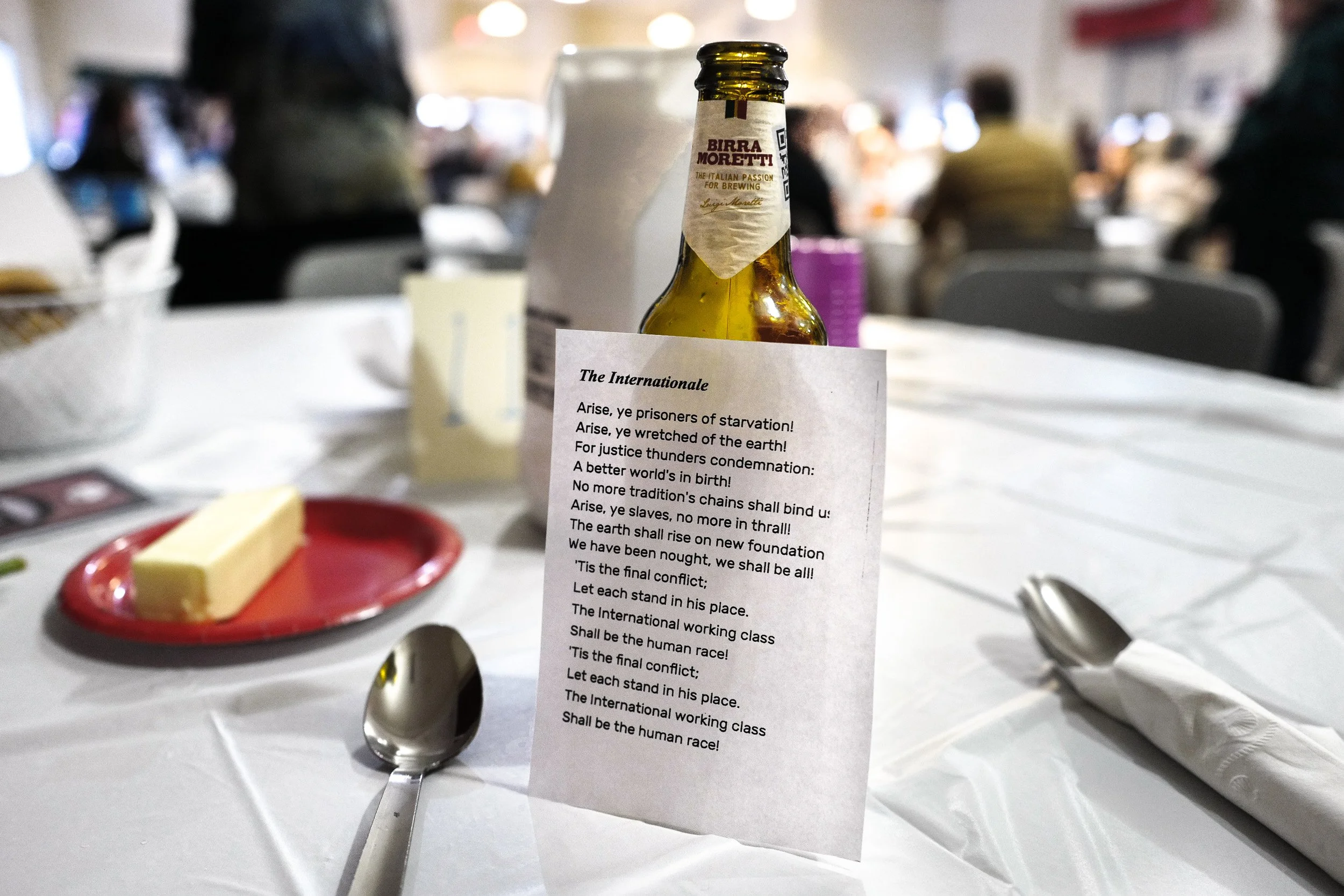
[Above photos: Roses left on front steps of the Hall in remembrance of the killing of Elia Corti, Primo Maggio silent auction table, Primo Maggio crowd seated between courses, Lyric sheet to ‘The Internationale’]
Using various historical examples, Prof. Loomis stressed the importance of the role of government in the success or failure of workers' struggles—something our current moment has disastrously demonstrated. The people who built the hall understood this, as they braved one of the most repressive eras in labor history. Yet through their perseverance, they would elect multiple socialist candidates into local public office out of the ranks of the hall. During the event's Q&A session, a woman named Bern Rose stood up and announced she was running for Mayor, expressing her frustration with the city's status quo and low voter turnout. Greeted by a round of applause, it was a real-time blossoming of community building and organizing for political change in the spirit of the hall's tradition.
In the midst of the festivities, another wonderful story of culture, history and community sat in the middle of our table in the form of freshly baked sourdough bread. Upon its founding, the hall was created with the community in mind, establishing a grocery store cooperative in 1901. The high demand for fresh bread led to the creation of the Union Cooperative Store Bakery, constructed directly behind the hall. The bakery would change hands several times over the following decades, even spending some of its later years as a granite storage building. In 2004, the Barre Historical Society acquired the building and, years later, led another community effort to restore the structure with the intention of reopening a bakery on the historic site of the Union Co-op. In 2018, “Rise Up Bakery” opened its doors.
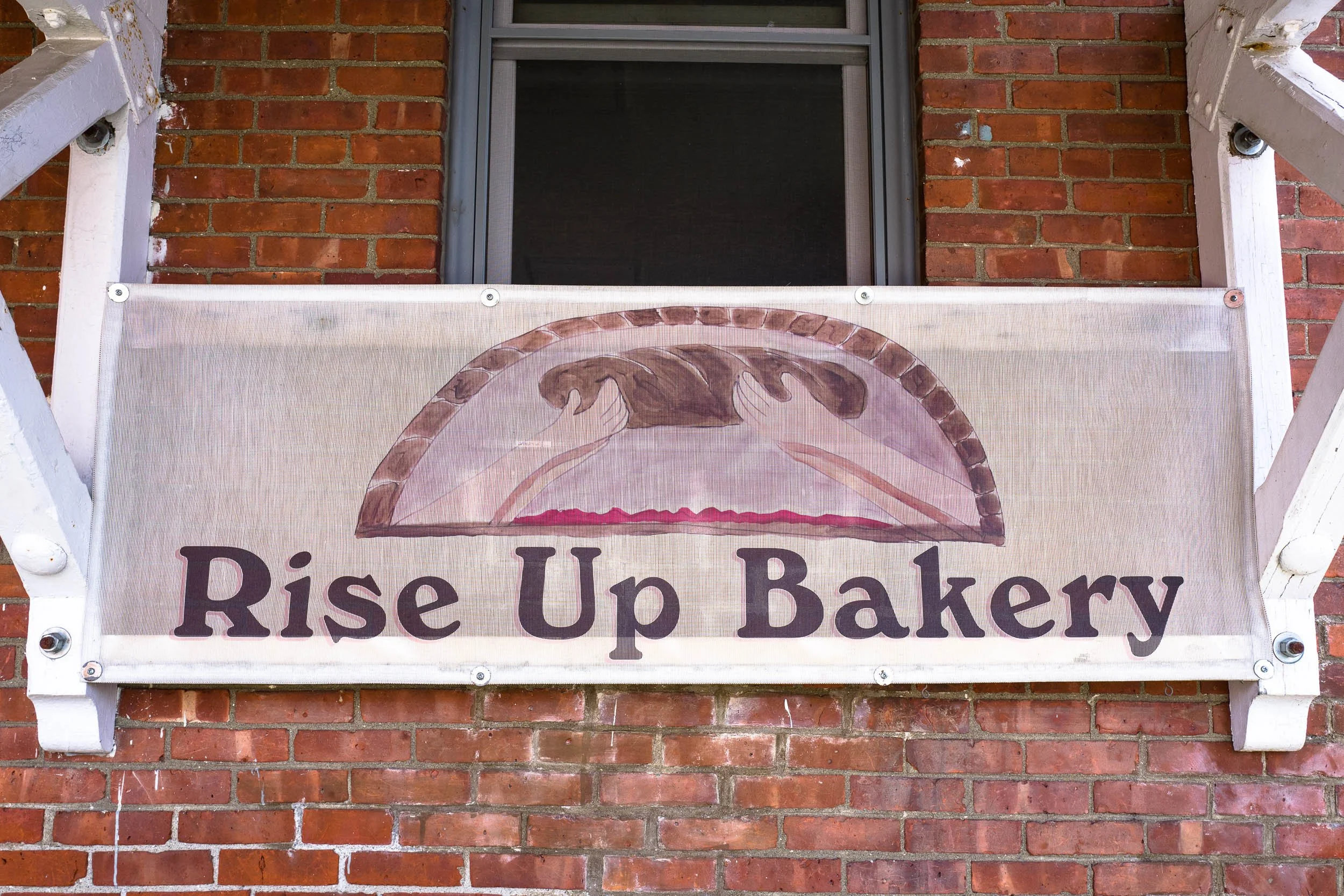
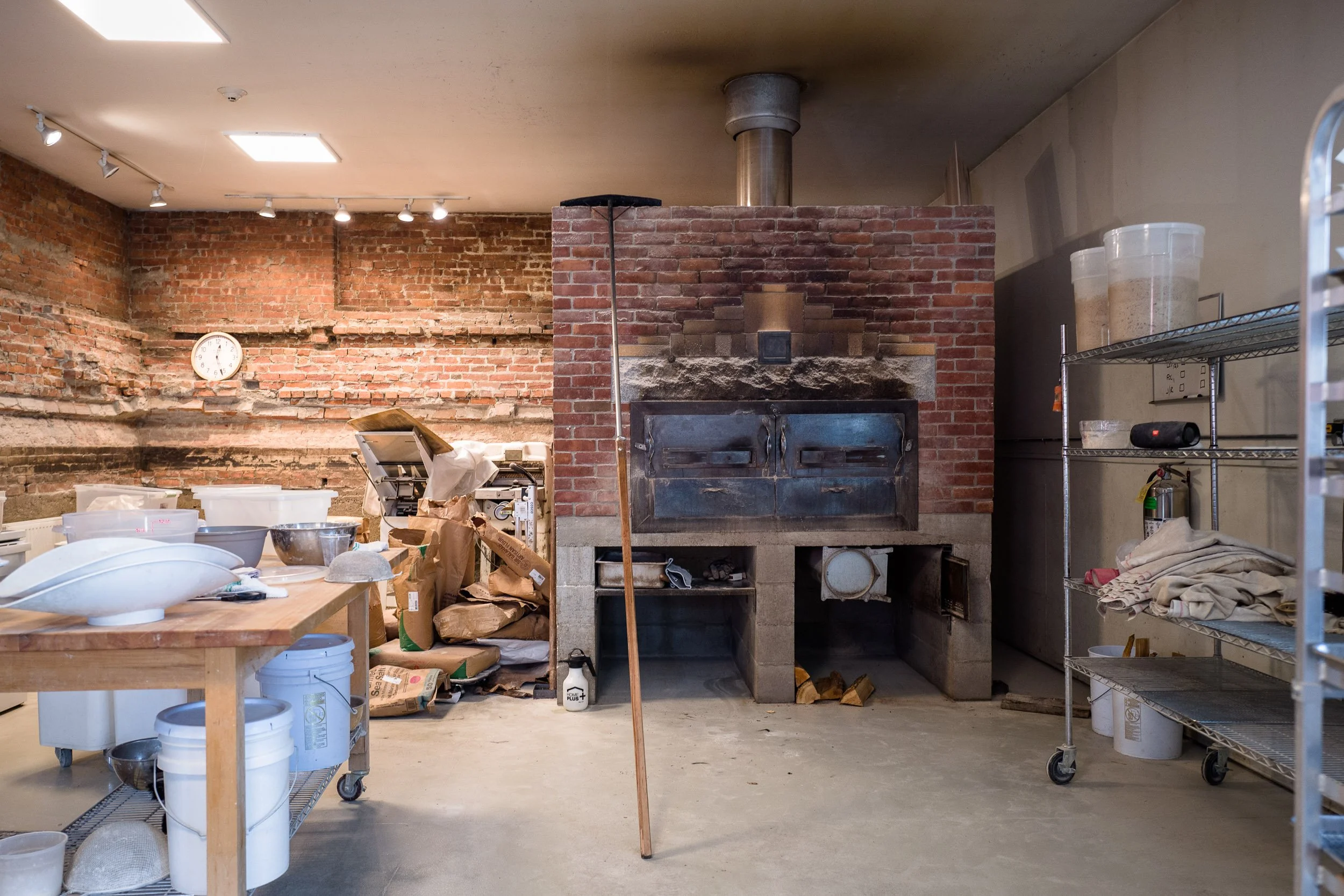
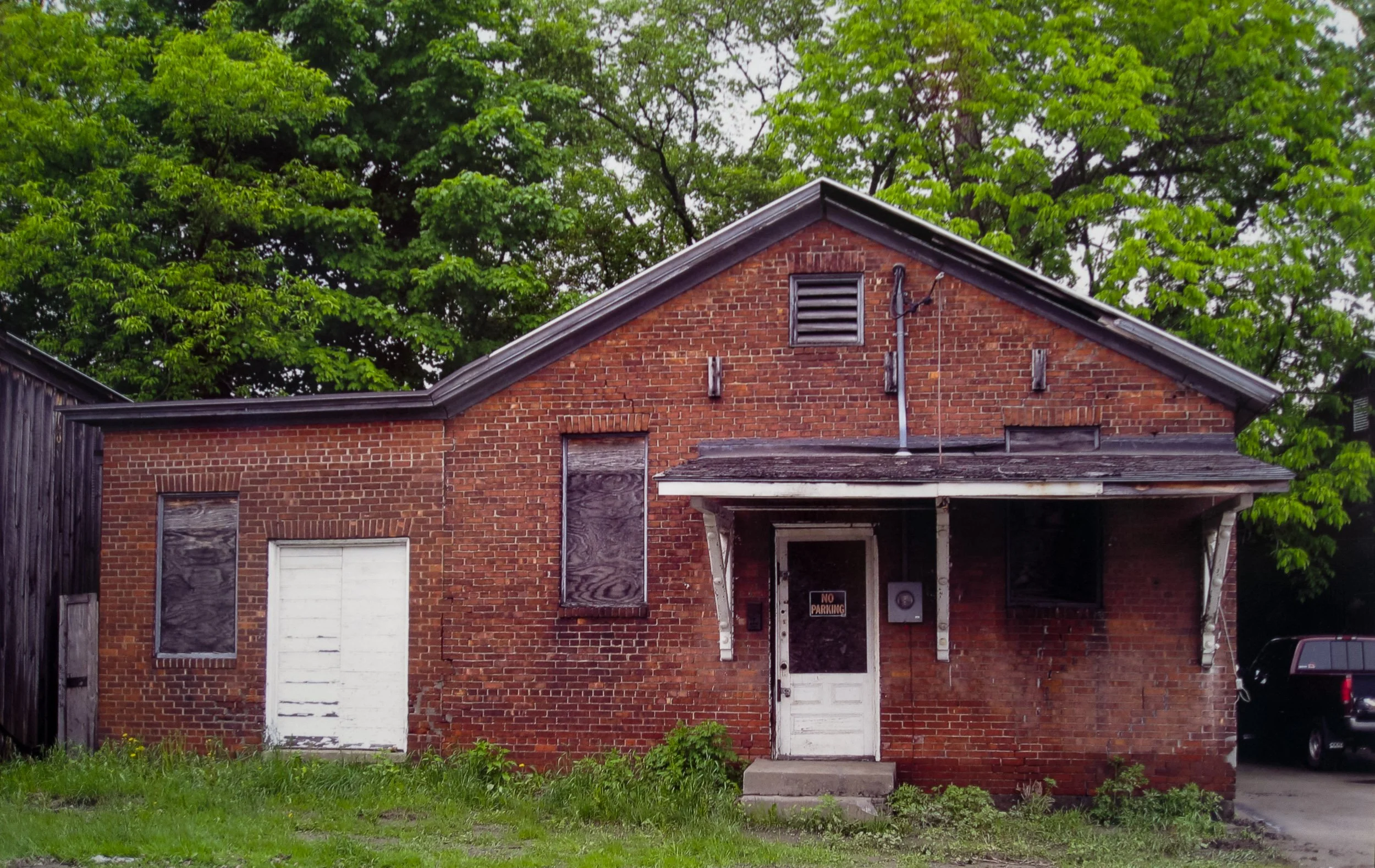
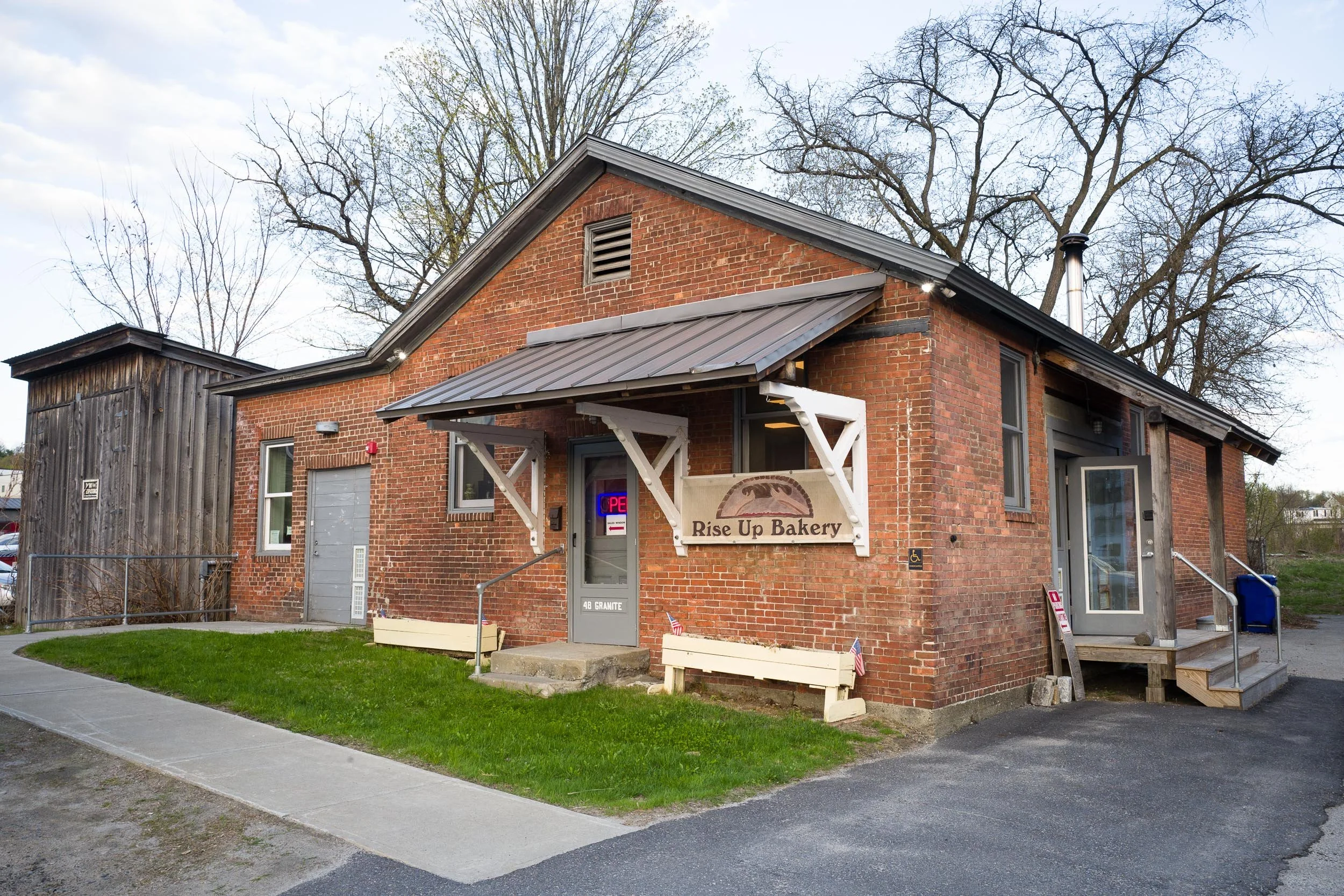
[Above photos: Sign for Rise Up Bakery, Renovated interior of bakery with the remnants of the massive brick oven from the Union Cooperative (top-left), Derelict structure prior to renovation (displayed at Old Labor Hall), Rise Up Bakery as it stands today]
Today the bakery is run by a husband and wife team, Jim and Larissa Haas. They moved back to Jim's home state of Vermont after years of running an artisanal bakery in Ukraine. The delicious breads they offer are truly of an international influence. One they are particularly proud of: the Fumagalli Italian rolls, named in honor of Batista Fumagalli who headed the bakery from 1910 to 1929. In socialist ethos, Fumagalli offered his bakers a work sharing schedule that allowed a larger number of people to benefit and kept the bakery thriving in harsh economic times. Jim and Larissa painstakingly recreated the specific Italian roll recipe baked on the premises a hundred years earlier. The simple act of breaking bread at Primo Maggio felt like an act of historical remembrance.
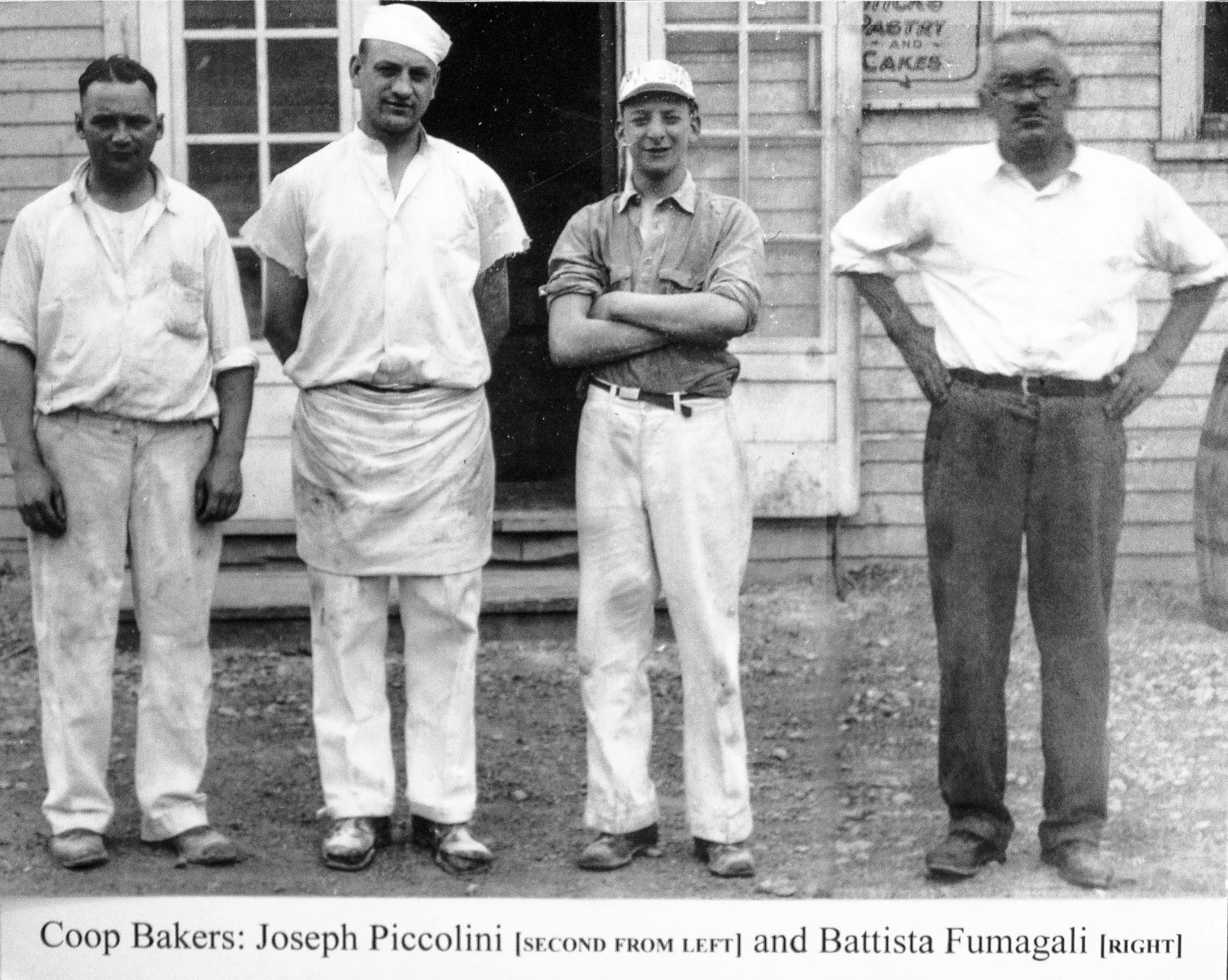
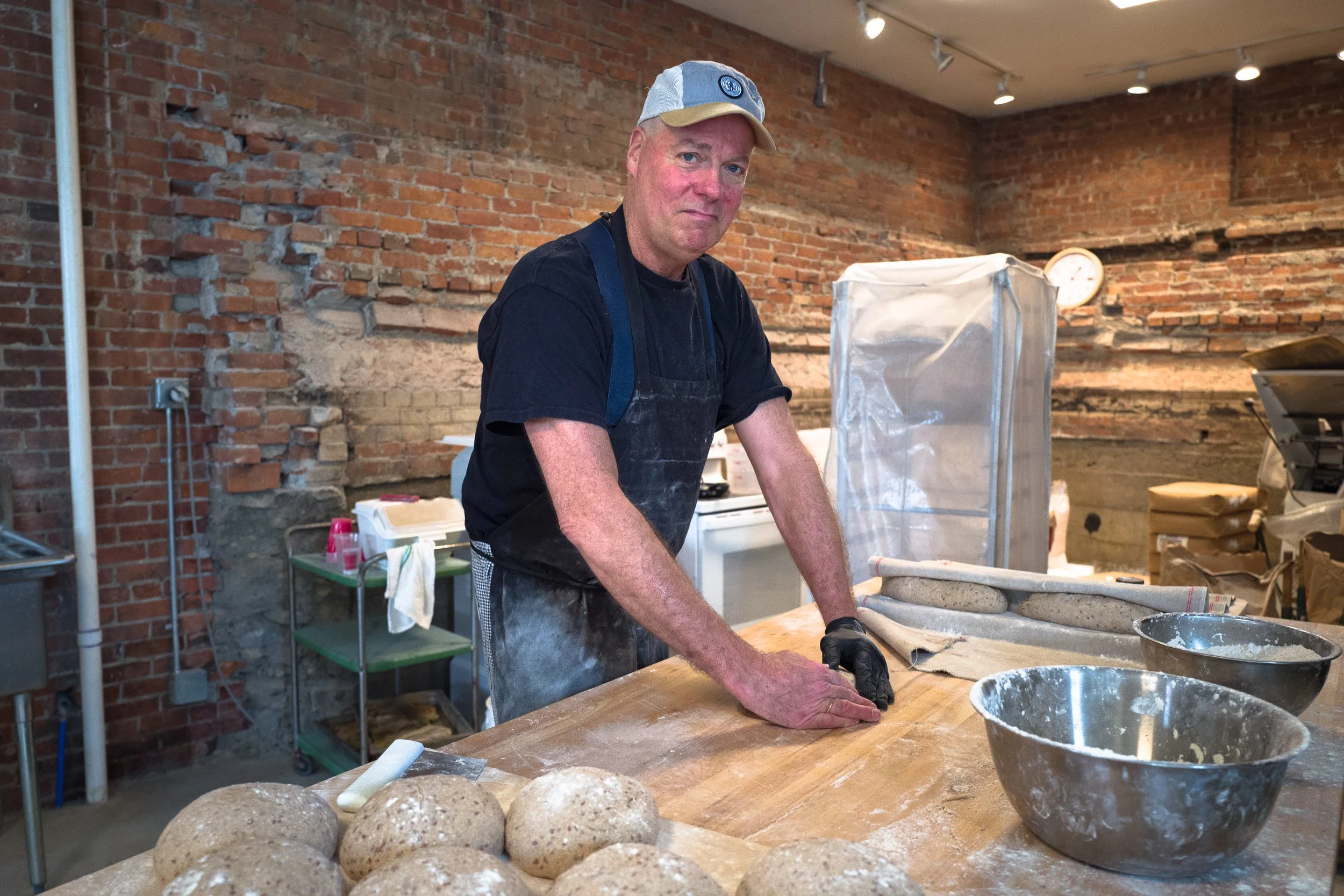
[Above photos: Historic photograph of Union Cooperative Bakers on display at Rise Up bakery, Baker, Jim Haas, shaping dough]
A noticeable and inspiring feature of the group of people organizing the Primo Maggio event was their intergenerationality—something that is often missing in efforts of labor history remembrance. One of the younger organizers I had the pleasure of meeting was Maia Gilmour. A musician, puppeteer, and teaching artist, working as the part time manager of the Old Labor Hall, Maia works with the board of the Barre Historical Society to help revitalize the hall as a vibrant community space and historical resource. She spoke to the importance of the intergenerational dynamic present at Primo Maggio: “The labor movement has afforded me possibility and comforts within the way that I approach work in the world, in ways that I don't even know...and I think that if the stories of the older generations that fought so hard for the labor landscape that we have right now, if those stories are not shared and passed on, so too are the inspirations and the hope of what's possible for the future of continued liberation.”
Maia Gilmour, artist and part time manager of the Old Labor Hall
Another distinguishing characteristic of Primo Maggio in Barre was how it seemed to effortlessly meld social life, culture and radical memory. On May Day at the hall over a hundred years earlier, members of the community were entertained by song and music, dined on Italian pastries while mindfully heeding socialist oratories. Social enjoyment, art and culture play a powerful role in reinforcing community politics, as well as its collective memory.
Another event organizer, Christopher Wiersema, a Vermont based media artist and educator has spent time immersed in just these themes. His experimental documentary film, Rough Blazing Star, revolves around radical memory in Barre, the hall and the legendary anarchist Emma Goldman and was the 2024 winner of the Vermont Public Award for Best Documentary at the Made Here Film Festival in Burlington. He spoke to the inspiration for the film that stemmed out of the city's unique local history:
“In Barre, VT, what we have is this amazing collection of memory...and physical spaces that are still around. There's also these stories that have been passed down that really define the people and the place just as much as the granite, the quarries, the industry, the granite sheds that are still there today...The role of an artist in a community, among many things, is to find these things that make us who we are in our history, in our memory and celebrate them and show them in new ways...find new ways to connect them to our contemporary times.”
Barre is quite extraordinary in that there are numerous physical reminders to the granite industry and the workers who sustained it—the town itself is nearly a sculpture garden. Granite sculptures dot the landscape, like the prominent Italian-American Stonecutter's Monument honoring the wide range of contributions Italian immigrants have made to the region. Erected in 1985, the sculpture is dedicated to Carlo Abate, one time editor of a local anarchist periodical, Cronaca Sovversiva, and sculptor who taught an evening drawing school at the Labor Hall. Giuliano Cecchinelli, who has been dubbed the city’s “last Italian stone carver,” created the pensive stonecutter sculpture looking out at a city which chiseled into being.
Hope Cemetery, just north of town, may have the most impressive collection of granite sculpture work anywhere in the country, as well as being peppered with various reminders of the city's radical history. The same Granite Cutters' International Association insignia carved on the headstones of some of its members at Hope Cemetery is the same insignia you will find carved on granite monuments and memorials erected around the country honoring those who perished for the cause of labor.
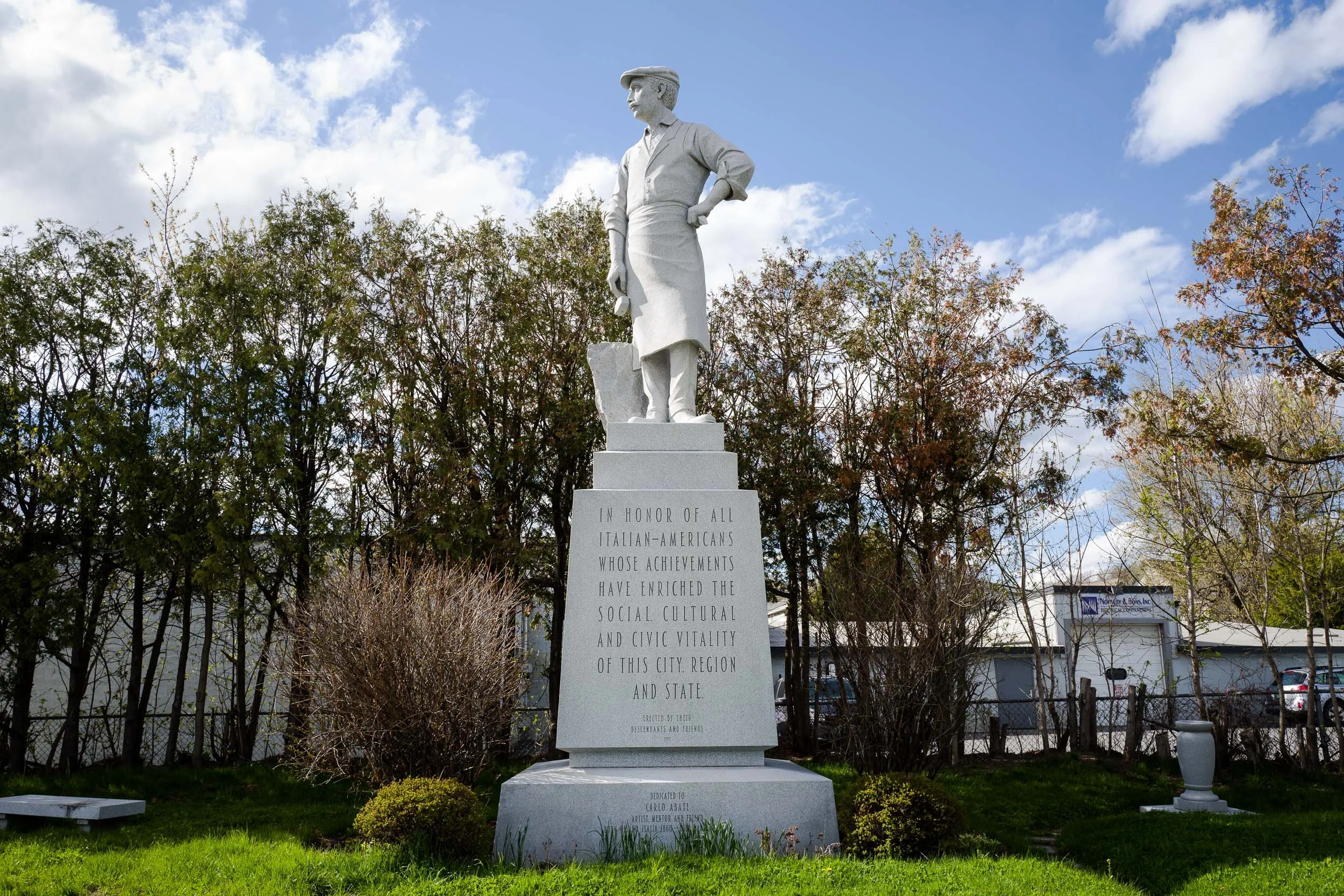
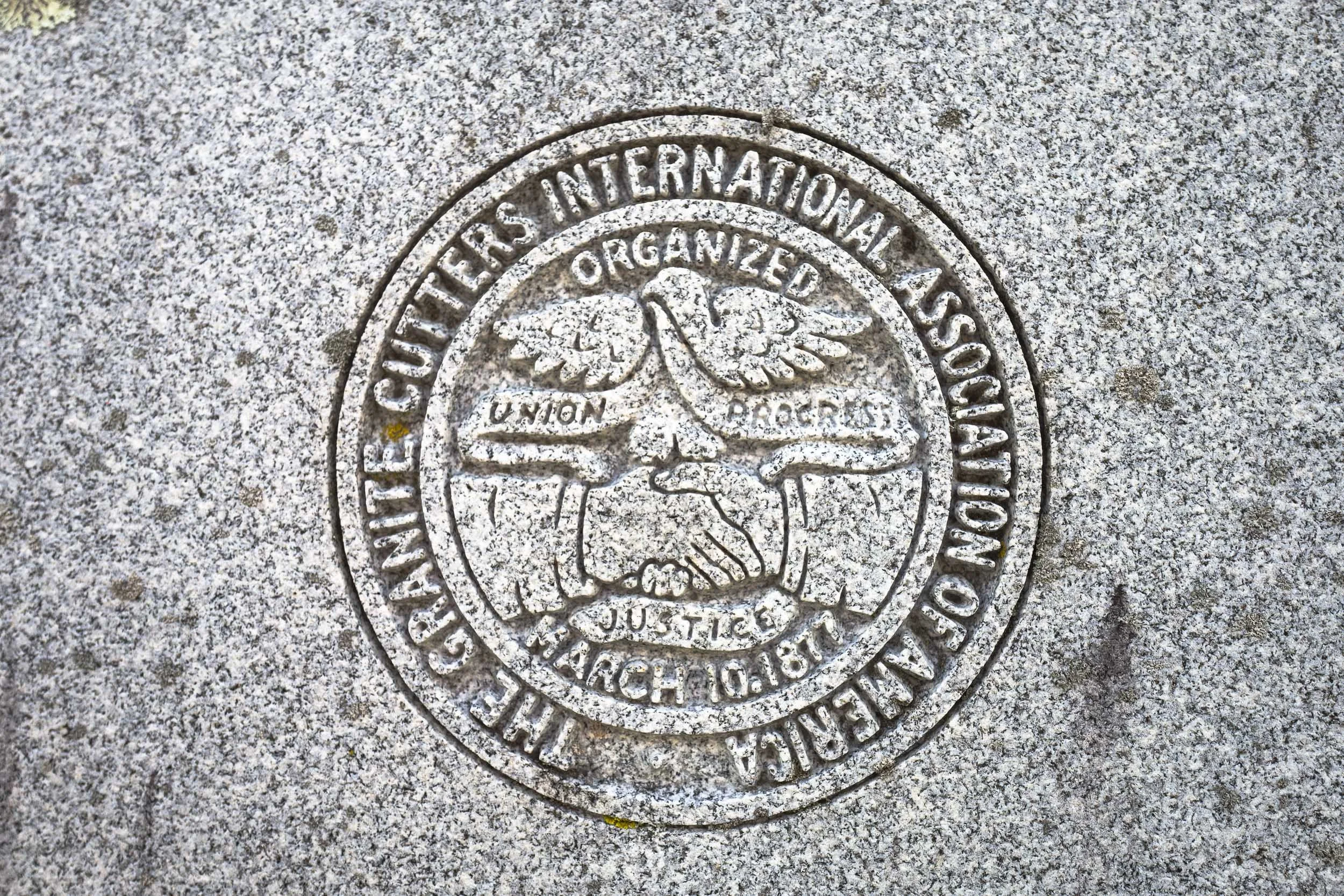
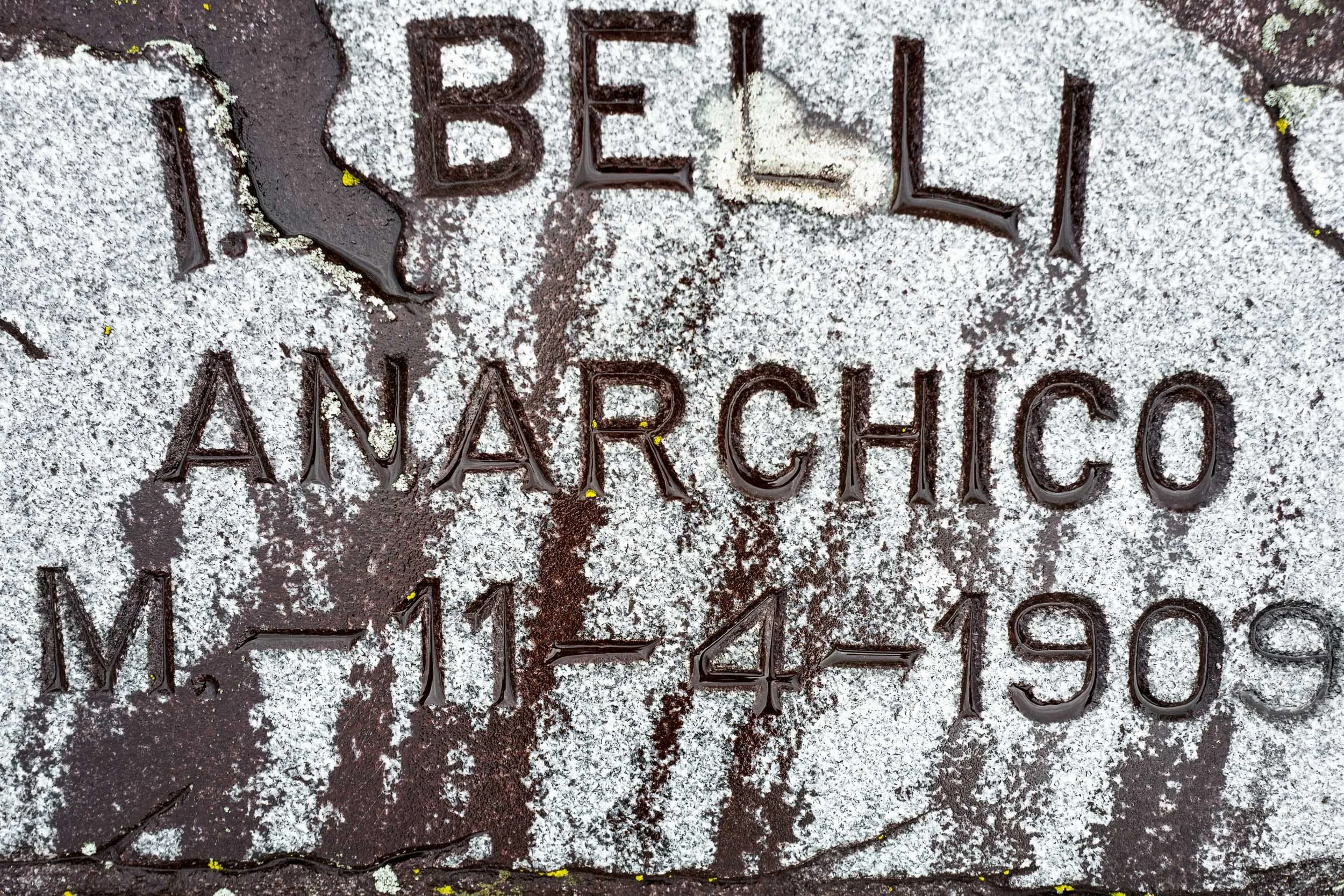
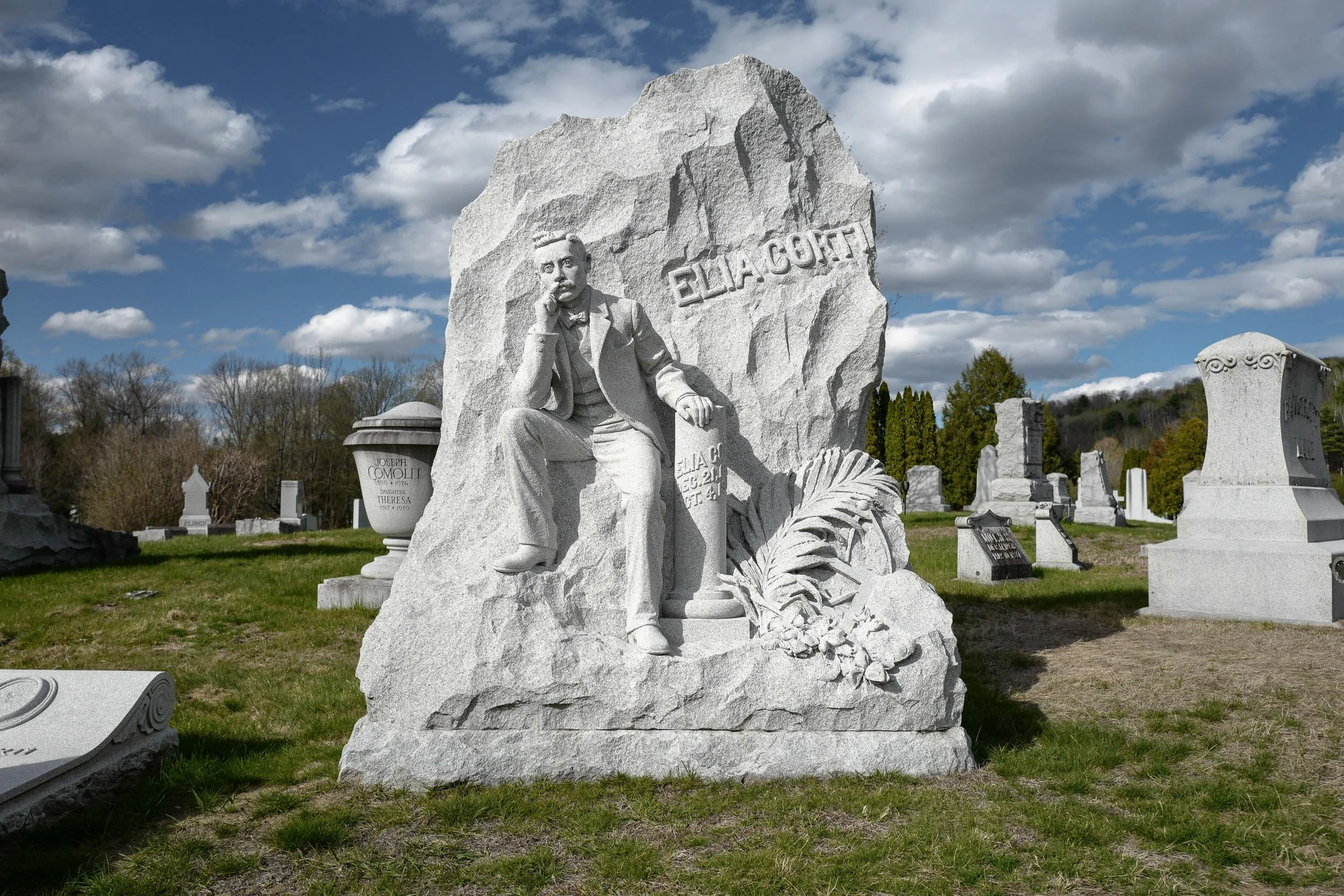
[Above photos: Stonecutter's Monument created by Giuliano Cecchinelli, Granite Cutters' International Association insignia on headstone, Headstone of ‘Anarchist’ at Hope Cemetery, Elia Corti sculpture]
One of the focal points of Hope Cemetery is a dramatic sculpture of a stonecutter carved from a single piece of granite: the gravesite of Elia Corti. The impetus for this immense memorial stems from a tragic incident at the Old Labor Hall on October 3, 1903, when the 34-year-old Corti was fatally shot—leaving behind a wife and two daughters. The violence erupted during a dispute between anarchists and socialists as they awaited a speaker known for his emphatic criticism of local anarchist leader Luigi Galleani. While Corti’s exact motives for entering the fray remain unknown, he had affiliations with both ideological factions and may have been attempting to act as a peacemaker when he was struck down. Corti is immortalized by this haunting likeness—carved by his own brother—which serves as a tribute to both the city's stone-cutting trade and its often complicated radical history.
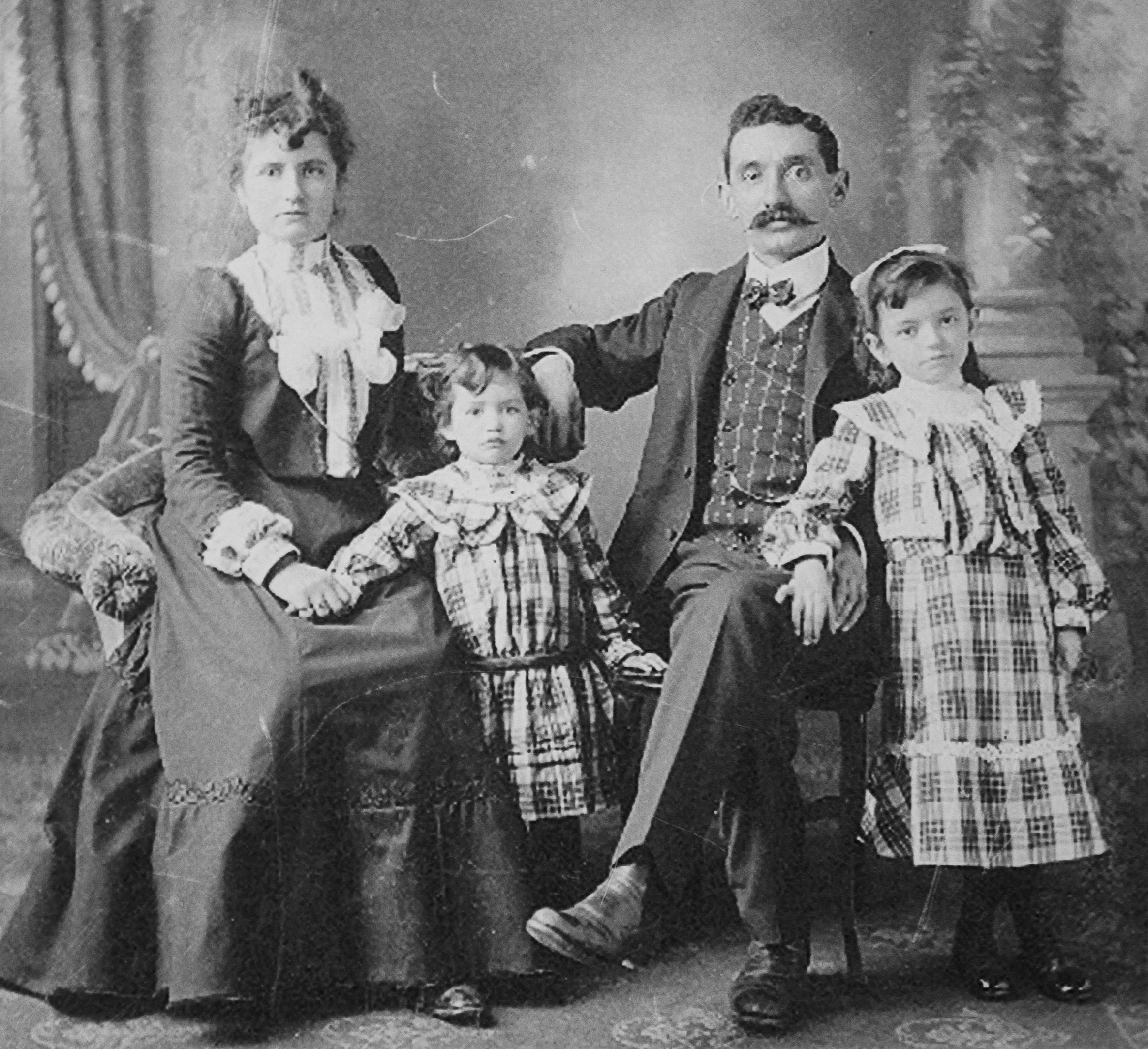

[Above photos: Corti family portrait on display Old Labor Hall, Detail of Elia Corti sculpture]
There is an insightful essay titled, “Interpreting Barre, Vermont's Granite Industry in All Its Rich Complexity,” that chronicles in detail the historical remembrance efforts in the city. It is a chapter in a wonderful book, Where Are the Workers? Labor's Stories At Museums and Historic Sites—which coincidentally also happens to contain a chapter by the same Primo Maggio keynote speaker, Prof. Erik Loomis. He ends his chapter with this note, “Fighting to preserve our sites of labor history...is not an easy task and is an addition to the work and struggles we take on every day, but it is also worthy work that will provide ourselves and our descendants a more honest examination of our nation's history.”
The Old Labor Hall in Barre is a perfect example of this: it preserves a part of working class history that has almost entirely been wiped off the map. A brick and mortar socialist hall is an astonishing artifact in the American landscape. It is a remaining relic of what was once a network of socialist meeting halls across the country, which supported hundreds of widely read publications and successfully supported the election of over a thousand socialists into office across the country during the early decades of the last century. The Old Labor Hall is a physical reminder of this history, but it is the culture that continues to thrive within which is the real source of its beauty and strength. As they state, the annual tradition of the Primo Maggio event commemorates “the combination of militance and enjoyment of life exemplified by the founders of the Hall.” In other words: radical labor history for the mind and cannoli and grappa for the soul.
Participants of Primo Maggio celebration gathered in front of the Hall in 1904—displayed at Old Labor Hall
*Correction from audio segment: As noted in the essay, Carlo Abate, was the one time editor of a local anarchist periodical, Cronaca Sovversiva, not the socialist publication, Il Proletario, as was stated in the audio segment.